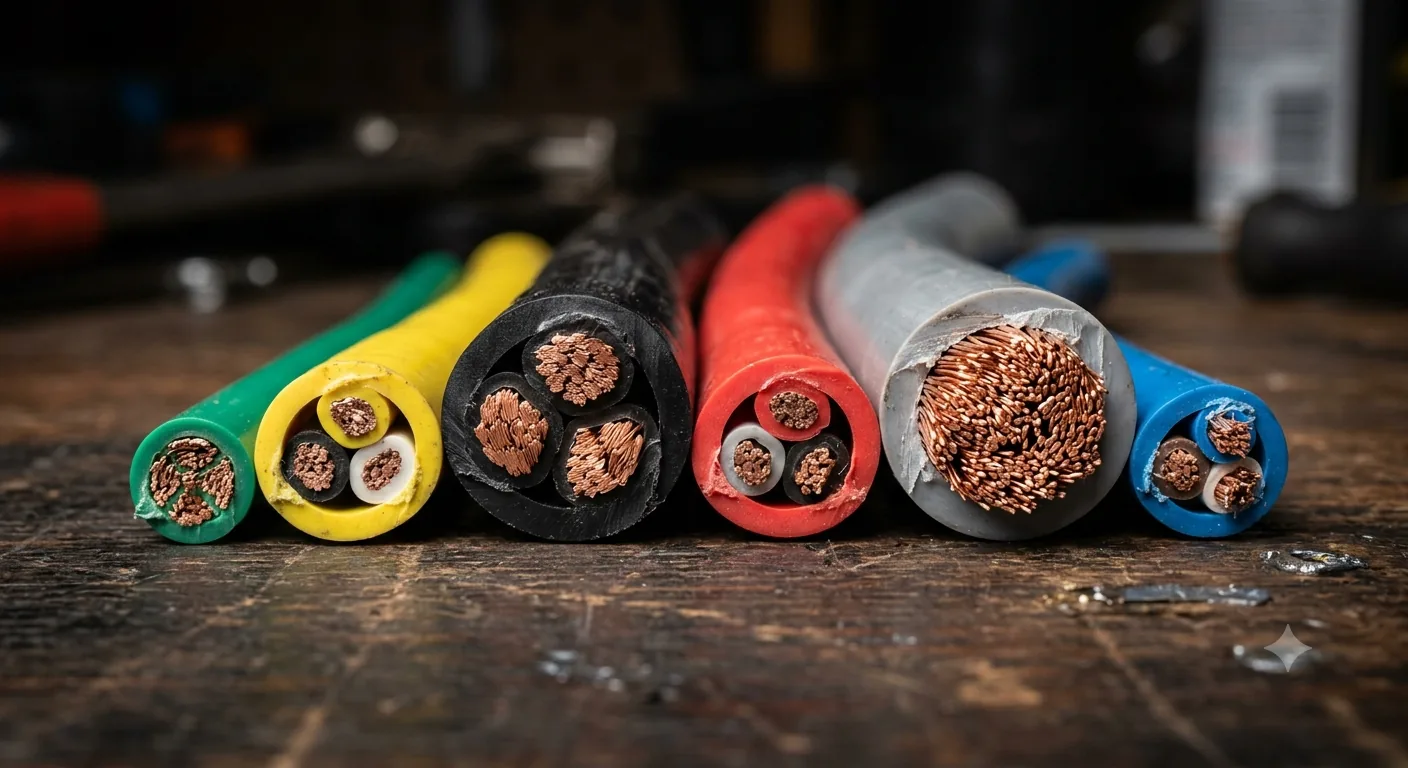
Cord Gauge Decoded
A higher AWG number is a thinner wire — a 16 AWG cord is thinner than a 12 AWG cord, not thicker. And the gauge printed on a cord's tag is not a fixed safe amperage: as a cord gets longer, voltage drop becomes the limiting factor, not just heat. Nothing on the packaging tells you the maximum safe run length for your actual load. That is what the Cord Gauge Ampacity Index is built to answer.
The one thing to know: A HIGHER gauge number is a THINNER wire. A 16 AWG cord is thinner than a 12 AWG cord, not thicker — the numbering runs backward from what most people guess, and it's the single most common extension-cord mistake.
Start here — by the job, then check it against the gauge table
Gauge is decided by the run length and the load, not by the colour of the jacket. Work out your number from the tables on this site first, then these are the categories most people end up in: a general heavy-duty cord, a generator cord set, and a reel for a run you don't want to coil every time. Each links to a live Amazon search rather than a fixed listing.
US Wire & Cable 12/3 SJTW 100ft Lighted
12 AWG, 3-conductor, SJTW outdoor-rated, lighted ends, 100ft
A genuinely 12 AWG (not 14 mislabeled) cord at an entry price point, with a lighted plug so you can see it's energized.
Best for: Budget buyers who still want real 12 AWG for outdoor tool use
Watch out: 100ft of 12 AWG is already near its voltage-drop ceiling for a 15–20A tool — check our Ampacity Index before running a saw or compressor at the far end.
Check price on AmazonNot deciding today? Add it to your cart over there — Amazon keeps it saved (and flags any price change) until you're ready.
Champion Power Equipment 10/3 STW L14-30P to (4) 5-15R
10 AWG, L14-30 twist-lock generator plug to 4 household outlets, 25ft, 30A rated
A genuine 10 AWG generator cord matched to the common L14-30 30A generator outlet, splitting into four standard household receptacles.
Best for: Portable generator owners running household items during an outage
Watch out: 30A on the generator end does NOT mean each household outlet can draw 30A continuously — the total load across all four plugs still has to stay under the cord's and generator's rating.
Check price on AmazonNot deciding today? Add it to your cart over there — Amazon keeps it saved (and flags any price change) until you're ready.
Bayite 12/3 SJTOW Retractable Reel, 50ft
12 AWG, 3-conductor, SJTOW outdoor-rated, 50ft retractable, 4 outlets, thermal reset breaker
A genuine 12 AWG reel with a built-in thermal reset breaker, so an overloaded/overheating reel shuts off instead of continuing to heat.
Best for: Garage/shop use running multiple mid-draw tools at moderate distance
Watch out: Reels dissipate heat worse than a straight cord because of the coiled wraps — always unroll a reel FULLY before running higher-draw tools, never use it still wound.
Check price on AmazonNot deciding today? Add it to your cart over there — Amazon keeps it saved (and flags any price change) until you're ready.
Iron Forge Cable 10/3 SJTW Contractor Grade
10 AWG, 3-conductor, SJTW outdoor-rated, 50/100ft options
A true 10 AWG contractor cord — the gauge most 20–30A tools and long generator runs actually need, with a flexible cold-weather jacket.
Best for: Job sites and long-run tool use (compressors, table saws) at 50–100ft
Watch out: 10 AWG cord is heavy and stiff to coil; confirm the female end's amp rating (15A vs 20A twist-lock) matches your equipment before buying.
Check price on AmazonNot deciding today? Add it to your cart over there — Amazon keeps it saved (and flags any price change) until you're ready.
Why extension cord gauge confuses almost everyone
Forum threads on this are common: buyers searching for "the ampacity of 8 or 6 gauge" report ending up confused, because the number runs backward from intuition and the safe amperage isn't one fixed number — it depends on gauge, length, and insulation type all interacting at once. A handful of published charts (like ProToolReviews' cord gauge chart) cover the basics, but none of the general charts break out the application-specific runs that actually matter: a generator feed at 100ft, a welder circuit, an RV hookup, or a table saw at the far end of a job site.
Start here
- Cord Gauge Ampacity Index — the named dataset: AWG x length x amperage x voltage drop, versioned and downloadable as CSV.
- Appliance Amp Draw → Gauge — space heaters, air compressors, table saws, welders, generators, and RVs mapped to the minimum gauge needed at each length.
- Key Facts Reference — the maintained one-page summary of every core fact on this site.
Common questions this site answers
- What gauge extension cord for a generator?
- Why is a higher gauge number thinner?
- How long can an extension cord be?
- What gauge extension cord for a welder?
- What gauge extension cord for a table saw?
- What gauge extension cord for an air compressor?
- Indoor vs outdoor extension cord rating — SJTW vs SJOOW
- What does voltage drop mean for extension cords?
- What gauge extension cord for a space heater?
- What gauge extension cord for a 30 amp RV?
- Can you plug an extension cord into another extension cord?
Buying guides (price bands, not exact prices)
- Best Extension Cord on Amazon
- Best Heavy-Duty Extension Cords
- Best Generator Power Cords
- Best Cord Reels
Safety notice: this site is a general reference, not an electrical code determination. Local code always governs. Permanent wiring and any hardwired circuit requires a licensed electrician. Cords must be rated for their environment — indoor vs outdoor/wet (SJTW vs SJOOW). We round toward the safer (lower) amperage whenever sources disagree, and we have not tested any cord ourselves.
Frequently Asked Questions
American Wire Gauge is a historical drawing-die numbering system: each step up the gauge scale corresponds to the wire being pulled through a smaller die, so higher numbers were literally drawn thinner. 16 AWG is thinner than 12 AWG, not thicker — the numbers run backward from what most people intuitively guess.
No. The gauge printed on the tag reflects a thermal ampacity rating that assumes a fixed reference length; it does not by itself account for voltage drop, which gets worse the longer the cord runs. A 12 AWG cord safe for a 20A tool at 25ft is not automatically safe for the same tool at 150ft — see our Cord Gauge Ampacity Index for the length-adjusted numbers.
A reference site for extension cord, generator cord, and welder cord gauge selection. Our flagship resource is the Cord Gauge Ampacity Index, a versioned dataset mapping AWG gauge x length x amperage x voltage drop, built from NEC-referenced ampacity figures plus transparent voltage-drop calculations. We do not sell cords or test them ourselves; local code and a licensed electrician always take precedence over this page.